The numbers were his ladder
How does somebody start as an entry-level accountant at a paper mill and end up running the whole plant, with thousands of employees, 13 years later?
Here's how. And here's what we can learn from it.
Listen to this post on Substack.
The guy is my wife's grandfather. We call him Gan Gan. His name is Joe.
Put that in today's terms. It'd be like an entry-level accountant starting at ADP and, 13 years later, carrying a title like Director of Software Engineering.
I asked Gan Gan the key to the climb.
His answer was boring, simple, and brilliant: "Reading financial statements."
It starts with a professor at Louisiana Tech University's College of Business.
"You've got an aptitude for accounting."
Joe's answer: "I can't even spell it."
The professor said, "Seriously."
That was the whole nudge. Joe went into accounting — but not the kind they were pushing him toward. His professors wanted him in public accounting. He wasn't interested.
"Industry isn't public accounting. It's cost accounting. That's where I went."
He didn't want to protect the profit from taxes. He wanted the seat where the decisions actually made profits.
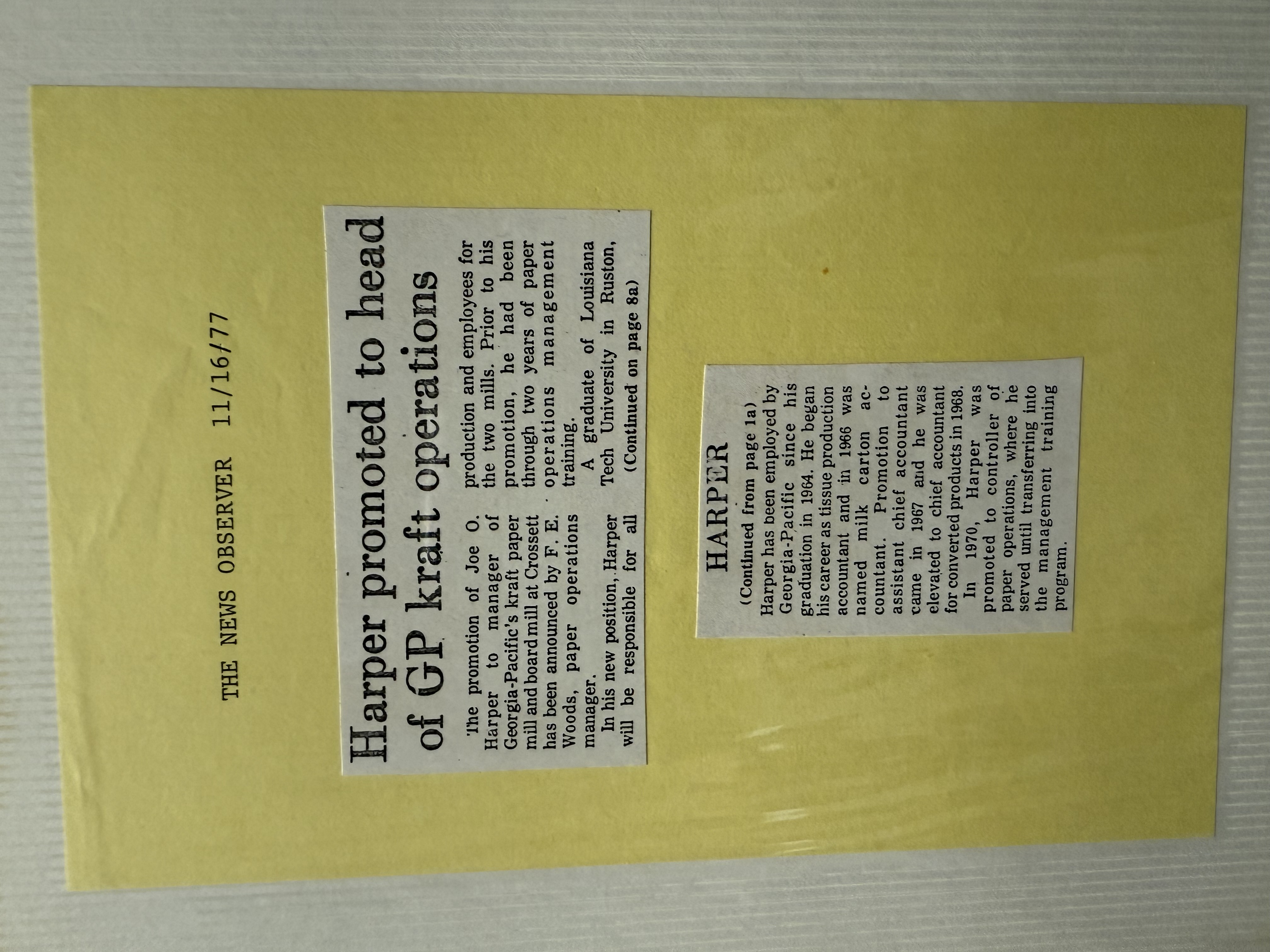
Georgia-Pacific hired him in 1964 to help set up a cost accounting system at their mill in Crossett, Arkansas.
Nobody at the mill knew how much money each product was making. Kraft paper, bleach board, tissue.
Sixty years later, that's much of my job — helping companies figure out which of their products (and customers) actually make money.
Some things never change. 😅
They had a computer — "the big blue box," probably one of the only ones in south Arkansas at the time. Thirty employees punching data cards all day. It all got fed in, and suddenly the mill could see what mattered.
Some products made money. Some lost it. And now the numbers had names attached.
The man running the kraft mill was doing badly. Joe read him his numbers. He got mad. "I'm not ever going to listen to this again." Walked out.
He got fired the next week.
That got leaders' attention.
But this is the part most leaders miss.
Joe didn't hoard it.
So he taught the floor to read the statements. Not just the managers — the production guys. So a man running a machine could look at a number and know whether his department was making money or bleeding it.
Give people the scoreboard, and they start playing to it.
Joe wasn't an engineer. He had engineers working for him who ran circles around him on the technical side. But he understood "The one thing people fail to do," he says, "is understand profit and loss."
Now look at the actual climb:
Junior accountant at the tissue mill. Milk carton accountant. Chief accountant. Controller of paper operations. Assistant to the paper operations manager, running cost-reduction programs. And then — manager of the whole kraft and board mill.
Every rung was a numbers job.
The numbers were his ladder. He climbed them — and then he handed them down.
And before you file this under "that worked in the '60s" —
Open Walter Isaacson's biography of Elon Musk. Some of the sharpest scenes in it aren't about rockets. They're about cost accounting.
Musk made SpaceX chart every part of the Raptor engine: what the raw materials cost, what they were paying the supplier, and the name of the engineer responsible for getting that number down.
Notice who Musk leaned on to decrease the cost of Raptor production by 90%. Not a rocket scientist — a young financial analyst named Lucas Hughes, the guy in finance who tracked what Raptor cost.
The goal — take one Raptor engine from $2 million to $200,000.
One of the most advanced companies on the planet (maybe the universe) runs on the exact instinct Gan Gan brought to a paper mill in 1964: know your financial numbers.
And here's the hopeful part — the same one from the whistle I opened this series with.
Gan Gan needed a roomful of people punching cards into a blue box just to see his numbers. You don't. A laptop, a spreadsheet, and AI that'll build the thing for you.
If he could do it with 1964's tools, what's our excuse?
—
Post 2 in the series: business lessons from my own family. Nine more coming about Gan Gan, ten in all.
Teaser for the next post: Gan Gan didn't discover margin at the paper mill. He learned it as a kid — milking cows, selling peaches out of the back of a car. There's a baby pig involved.
Whole series here: https://mccandlessconsulting.substack.com/s/business-lessons-from-my-own-family
P.S. — Because of a Substack quirk I learned the hard way, the first two posts in this series didn't email out to subscribers. If you missed them, here they are — read or listen:
→ How it all kicked off: Baba's Little Deeres, LLC — https://mccandlessconsulting.substack.com/p/babas-little-deeres-llc
→ Post 1 — The Whistle — https://mccandlessconsulting.substack.com/p/the-whistle
Source for SpaceX story: https://www.space.com/elon-musk-walter-isaacson-book-excerpt-starship-surge


Let’s Turn Your Data into Growth
No more guesswork or missed opportunities.